
Network topology diagram
Topology is about shape rather than addresses: how nodes connect, and what happens when one link fails. The shape tells you the failure mode, which is why the diagram is worth drawing separately.
Most real networks are hybrids, and drawing the hybrid honestly is more useful than pretending it is a clean star.
#When to reach for one
Teaching or reviewing a design, where resilience is the question.
Comparing options before committing to cabling or peering.
Explaining why a single link is a single point of failure.
#How to draw it in Capable
Route | Use when |
|---|---|
Graphviz | Layout engines that suit mesh and ring shapes. |
draw.io | Annotated diagrams with real device icons. |
#A worked example
A partial mesh between four sites, with one weak link:
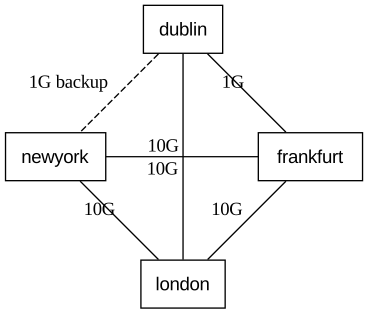
The source, which you can paste into a new diagram and edit:
#A few things that catch people out
Draw the redundant path differently from the primary one, or the diagram implies they are equal.
Label link capacity. A mesh where one link is a tenth of the others is not really a mesh.
Circular layouts suit ring and mesh; hierarchical layouts suit star and tree.
#Related
Somebody will read this at 3am. Be kind.