
Table
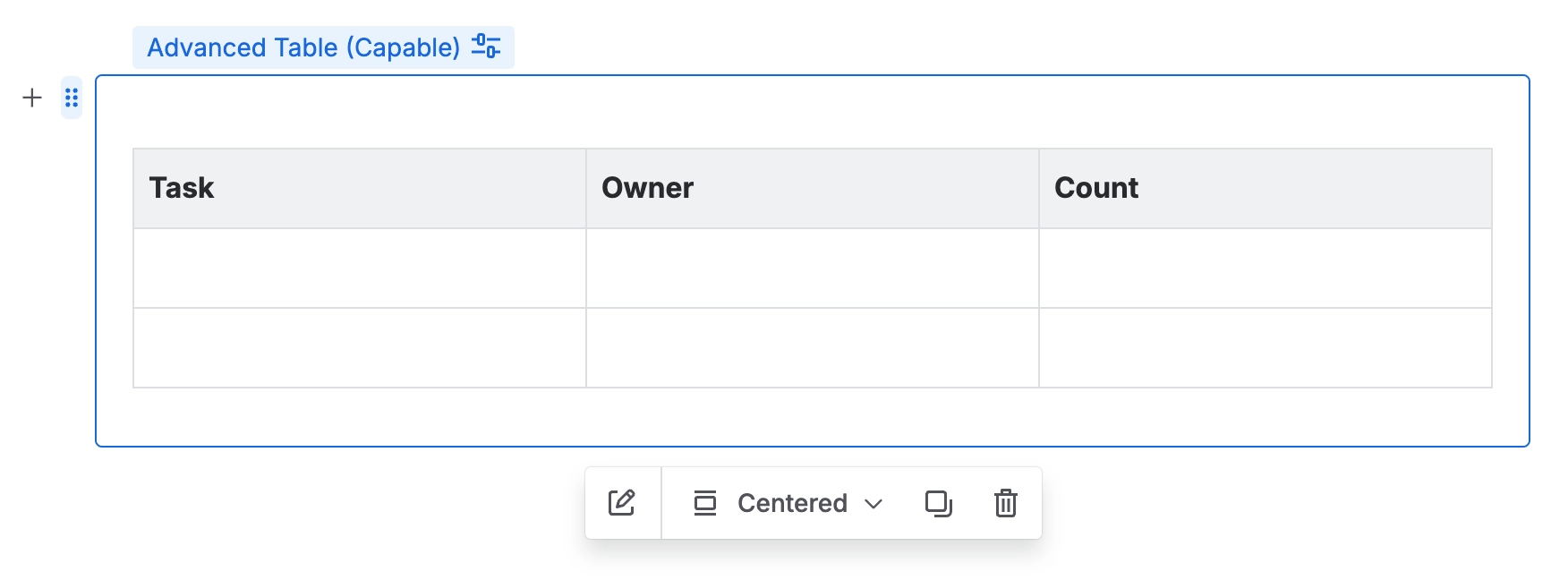
Wraps a table you write in the page and turns it into an interactive data grid with sorting, filtering, paging and (in the suite) grouping, pivots and charts.
You write an ordinary Confluence table inside the macro body and this turns it into a proper grid at read time: sortable columns, filters, pagination and column resizing, without moving your data anywhere. Because the source is still an ordinary ADF table, everyone edits it the normal way and nothing is locked into a proprietary store. In the Capable suite it goes considerably further - row grouping, pivots, a Columns & Filters side panel, cell-range selection and charts built from a selection - and a Save view button freezes whatever arrangement you have made onto the page for every later reader. This is the macro that owns charting in this capability; there is no separate chart macro.
#See it
Every example below is a real macro on this page, not a screenshot, and each one is a configuration taken from a page somebody actually built. Open this page in the editor to see how any of them is set up.
#14px
Task | Priority | Score |
|---|---|---|
Login flow 1 | Low | 5 |
Payment gateway 1 | Critical | 12 |
Search API 1 | High | 19 |
Dashboard UI 1 | Medium | 26 |
Notifications 1 | Low | 33 |
Onboarding 1 | Critical | 40 |
Billing export 1 | High | 47 |
Audit log 1 | Medium | 54 |
Rate limiter 1 | Low | 61 |
Webhook retries 1 | Critical | 68 |
Login flow 2 | High | 75 |
Payment gateway 2 | Medium | 82 |
Search API 2 | Low | 89 |
Dashboard UI 2 | Critical | 6 |
Notifications 2 | High | 13 |
Onboarding 2 | Medium | 20 |
Billing export 2 | Low | 27 |
Audit log 2 | Critical | 34 |
Rate limiter 2 | High | 41 |
Webhook retries 2 | Medium | 48 |
#Settings
Setting | Values | What it changes |
|---|---|---|
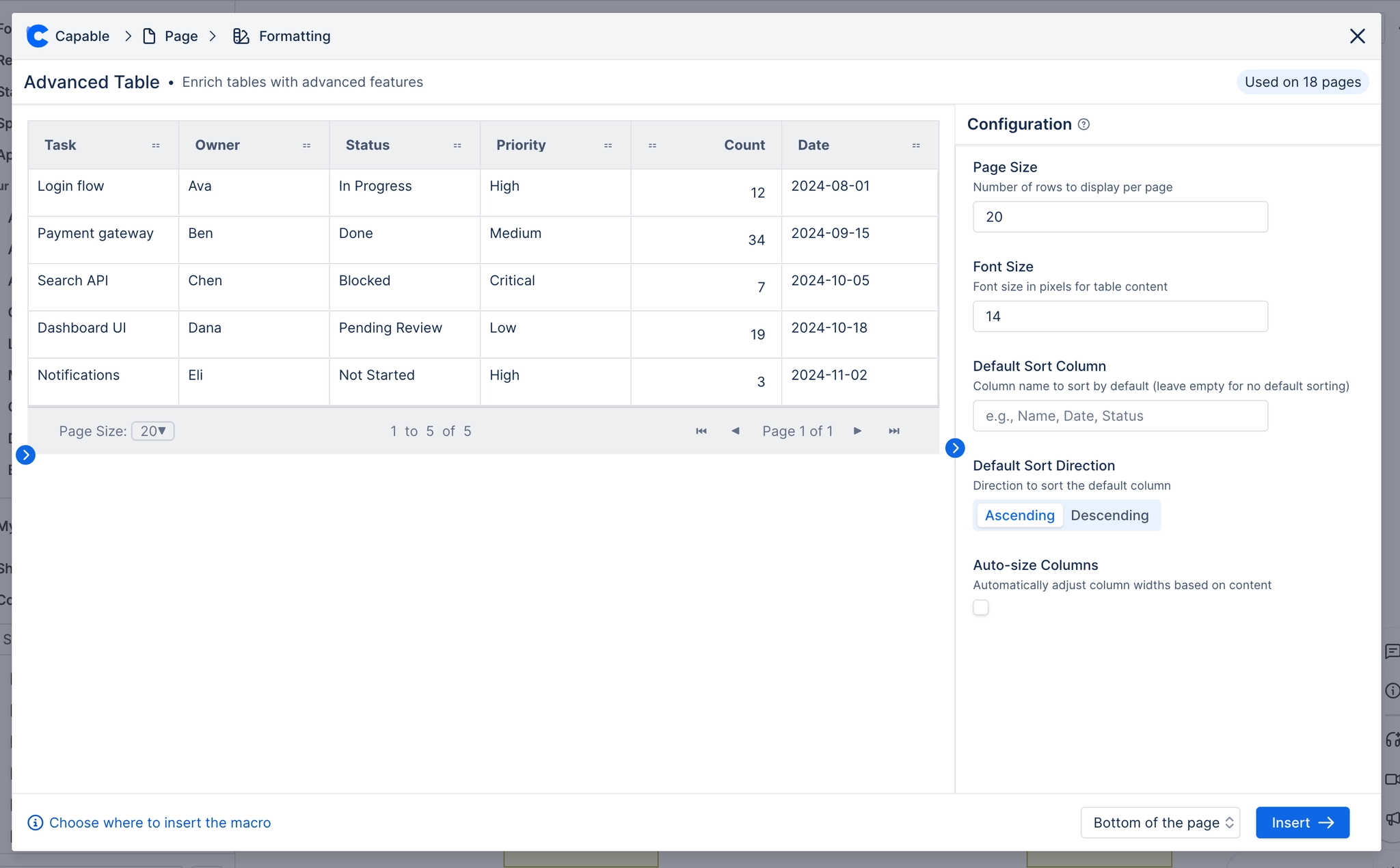
Page size | 10, 20, 50, 100, 250, 500 (plus whatever value the macro already carries, if it is not one of those) | Rows per page. Paging is switched off entirely when the view is grouped or pivoted. |
Font size | Pixels. Input offers 8–24; the renderer clamps to 8–48 (extra headroom for older macros) and rounds. | Drives the whole grid's text size through a scoped stylesheet keyed to this table instance, so several tables on one page can differ. |
Minimum height | Pixels. Input offers 0–2000 in steps of 40. | 0 means grow to fit the content. Any positive value fixes the grid's height, which is what you want when the side panel is open or the table is short. |
Auto-size columns | on / off | Sizes columns to their content instead of flexing them to fill the width. |
Background (under "Header colours") | A brand-scheme colour from the "background" category, a custom colour, or cleared | Column-header background. Applied as a scoped `!important` override because the ag-theme-atlassian theme hard-codes header colours and ignores the standard AG CSS variables. Only header cells are touched - never popups, paging or |
Text (under "Header colours") | A brand-scheme colour from the "text" category, a custom colour, or cleared | Column-header text and icon colour, applied the same way. |
#Related
The largest family, and the most precise.