
Footnote
Drops a small numbered marker like [3] into a sentence, with the note's text on hover, and feeds that note into the page's Footnotes summary.
Use this when a sentence needs a source, a caveat or an aside that would break the flow if you wrote it inline. You put the marker where the sentence is, and the actual wording lives in the footnote instead of cluttering the paragraph. The marker numbers itself from its position on the page, so you can add, delete or reorder footnotes and every number renumbers itself the next time the page is saved. Pair it with the Footnotes summary macro at the bottom of the page to get the collected list of notes; on its own the marker is still readable, because the text shows in a tooltip when a reader hovers it.
#See it
Every example below is a real macro on this page, not a screenshot, and each one is a configuration taken from a page somebody actually built. Open this page in the editor to see how any of them is set up.
#Demo quotation included for illustrative purposes
A footnote marker sits in the text like this[1], and collects at the foot of the page.
#A footnote usually contains supporting information
A footnote marker sits in the text like this[2], and collects at the foot of the page.
#For example, a term could be briefly defined here in
A footnote marker sits in the text like this[3], and collects at the foot of the page.
- Demo quotation included for illustrative purposes. Replace with a real source when using this pattern in production. ↩
- A footnote usually contains supporting information that is useful but not essential to the main sentence. ↩
- For example, a term could be briefly defined here instead of adding a long aside in the paragraph. ↩
#Settings
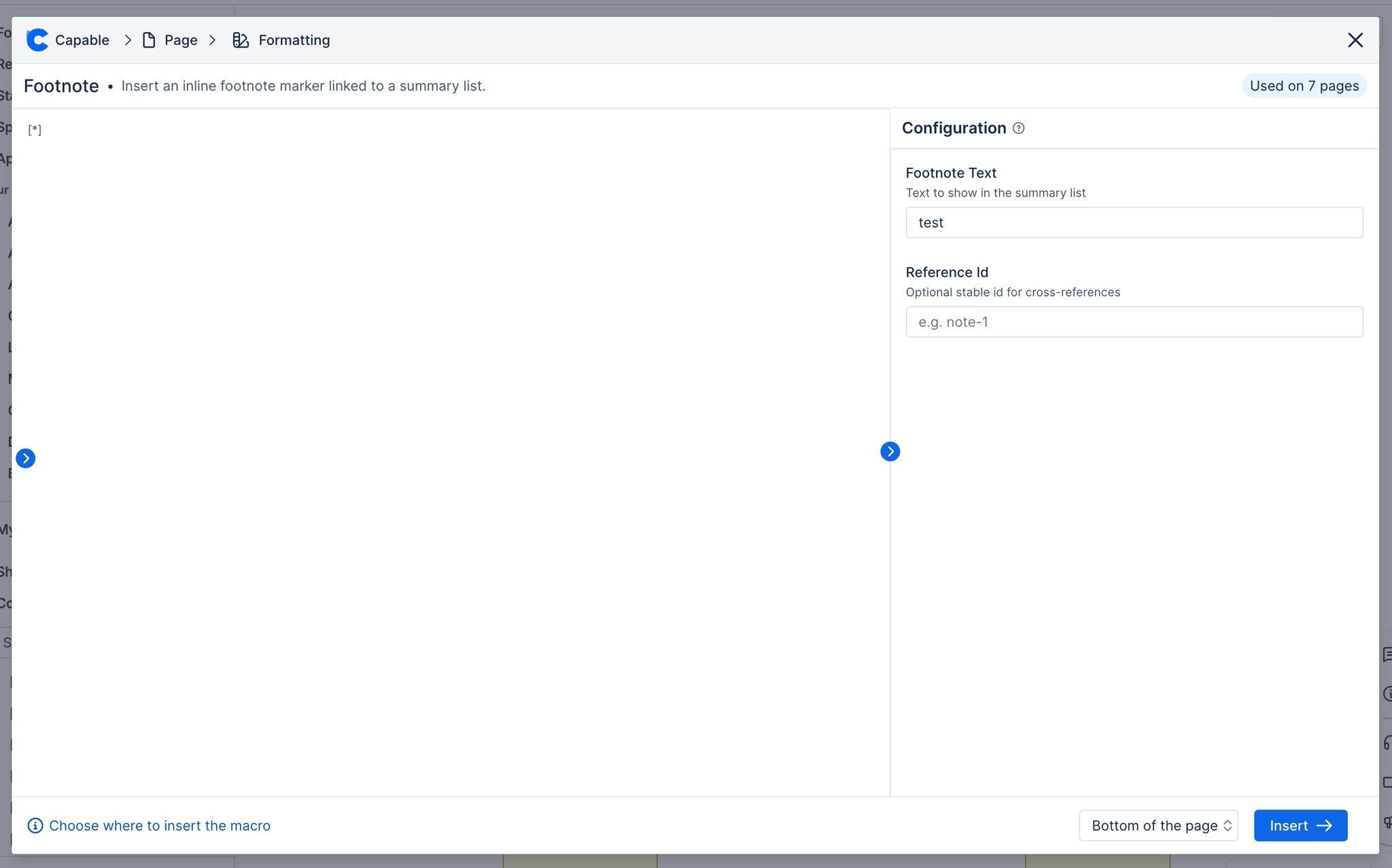
Setting | Values | What it changes |
|---|---|---|
Footnote Text | Free text, multi-line (the JSON-Forms control sets `options: { multi: true }`). No maximum length is enforced anywhere in the schema. | This is the note itself. It is what appears in the Footnotes summary list, and what a reader sees in the tooltip when they hover the marker. If you leave it empty the footnote is invisible to the numbering: the marker renders as [ |
Reference Id (optional) | Free text. The config form suggests a slug such as `note-1`. | Almost nothing a user can observe. It is only used as a fallback way for the marker to recognise itself when the internal instance id does not match - i.e. it can break a tie between two footnotes that would otherwise be indisting |
#Related
Numbered in place, collected at the foot.