
Metadata
Drops one piece of live page metadata, last updated, published date, version number, page title, space key, into a sentence as inline text.
Use it when a sentence in the page body needs to state a fact about the page itself and stay correct forever: "This policy was last reviewed on 25.09.2019 12:42", "Version 14 of the onboarding guide", "Published in space HR". Typing those by hand means they go stale the moment somebody edits the page; this macro re-reads the value from Confluence every time the page is opened. It is an inline macro, so it sits mid-paragraph rather than breaking the text into its own block, and it renders as plain text that inherits the surrounding styling. It is also the migration target for Handy Timestamp. In the Capable Suite it additionally exposes Capable's own timestamps, approval dates, publish dates, Sites export dates and slugs, so a page can display its own governance state.
#See it
Every example below is a real macro on this page, not a screenshot, and each one is a configuration taken from a page somebody actually built. Open this page in the editor to see how any of them is set up.
#A custom value
This page was last updated .
#CapableApprovalCompleted
This page was last updated .
#CapableSitesLastExported
This page was last updated .
#Settings
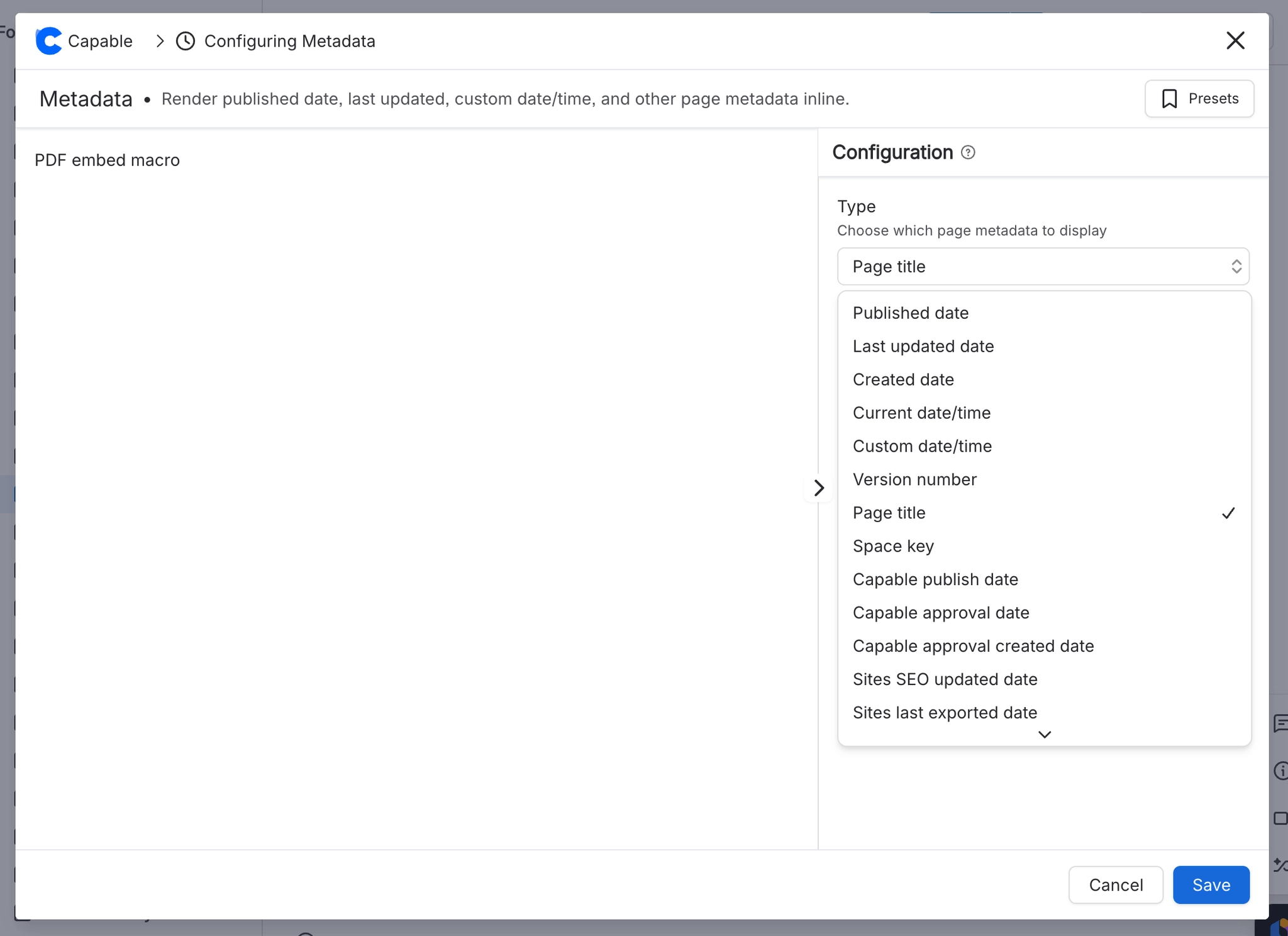
Setting | Values | What it changes |
|---|---|---|
Type | Always available: Published date, Last updated date, Created date, Current date/time, Custom date/time, Version number, Page title, Space key. Available only in an app that bundles the matching capability (i.e. the Suite, not standalone Formatting): Capable publish date, Capable approval date, Capable approval created date, Sites SEO updated date, Sites last exported date, Sites page slug. | Chooses which fact is displayed. Date types are run through the Format picker; Version number, Page title, Space key and Sites page slug are printed as-is. |
Value | Free text. Accepts dd.MM.yyyy, dd.MM.yyyy HH:mm, dd.MM.yyyy HH:mm:ss, or any ISO date string. Placeholder shown: 03.08.2026 08:31:08 | The date to display. Only shown, and only used, when Type is "Custom date/time". An unparseable value falls back to the Empty fallback text. |
Format | dd.MM.yyyy HH:mm (25.09.2019 12:42), dd.MM.yyyy HH:mm:ss (25.09.2019 12:42:13), MM/dd/yyyy hh:mm a (09/25/2019 12:42 PM), MMM dd, yyyy hh:mm a (Sep 25, 2019 12:42 PM), dd.MM.yyyy (25.09.2019), MM/dd/yyyy (09/25/2019), MMM dd, yyyy (Sep 25, 2019), Relative (3 days ago) | How a date/time is written out. Only shown, and only used, when Type is one of the date types. |
Empty fallback | Free text | Printed instead of the value when the metadata is missing, the page fetch fails, or a custom value cannot be parsed. It is also what is briefly shown while the page metadata is still loading. |
#Related
Small, and quietly useful.