
Site settings
Global settings sit in Confluence administration under Capable. Everything here is site-wide and needs a Confluence administrator.
One thing to know before you touch any of it: there is no Save button.
#The tabs
Tab | What it controls |
|---|---|
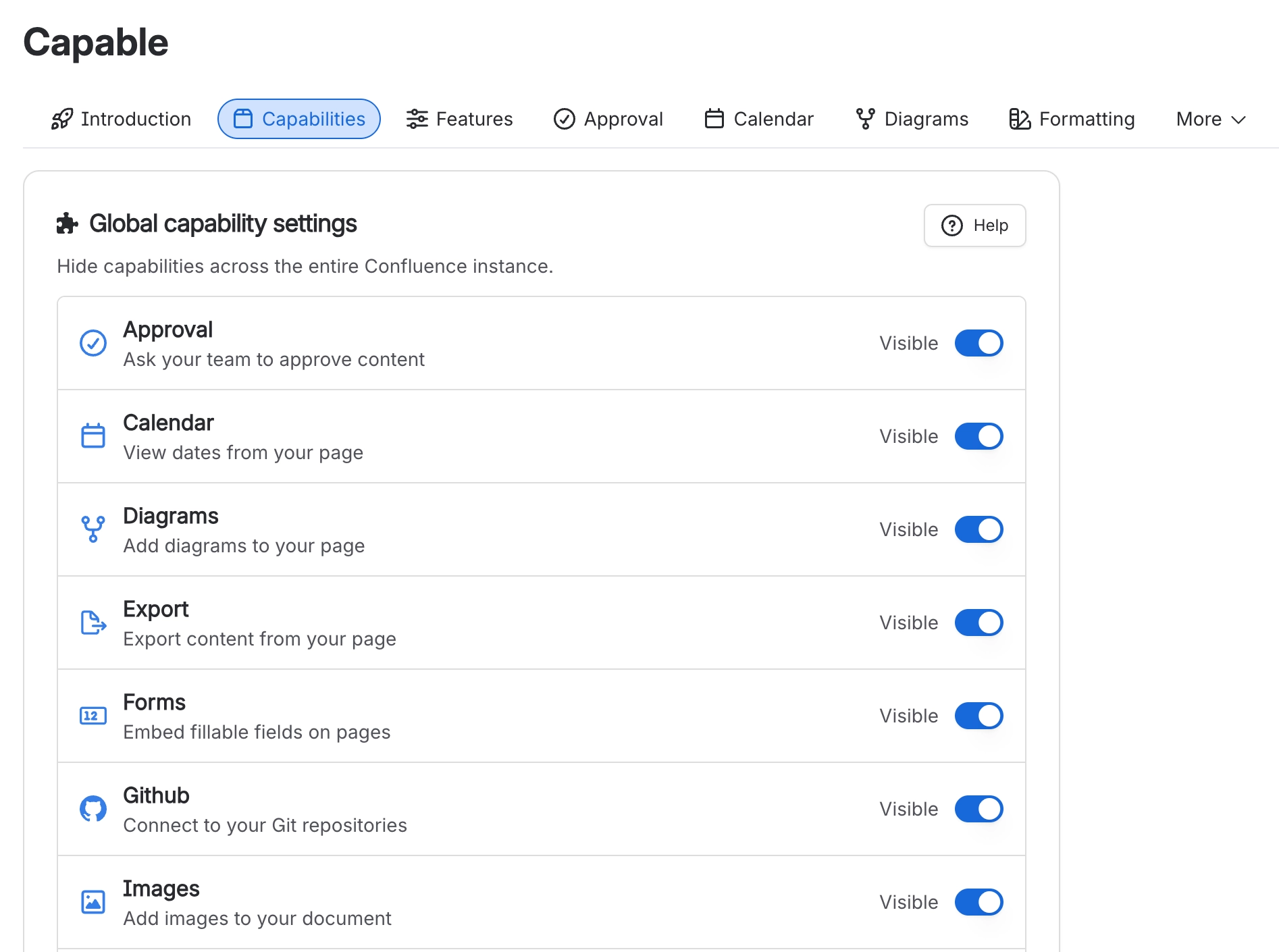
Capabilities | A Visible/Hidden switch per capability. Hiding removes the capability from the Capable nav, the Capable byline menu, the command palette and the search table's contributed columns and filter |
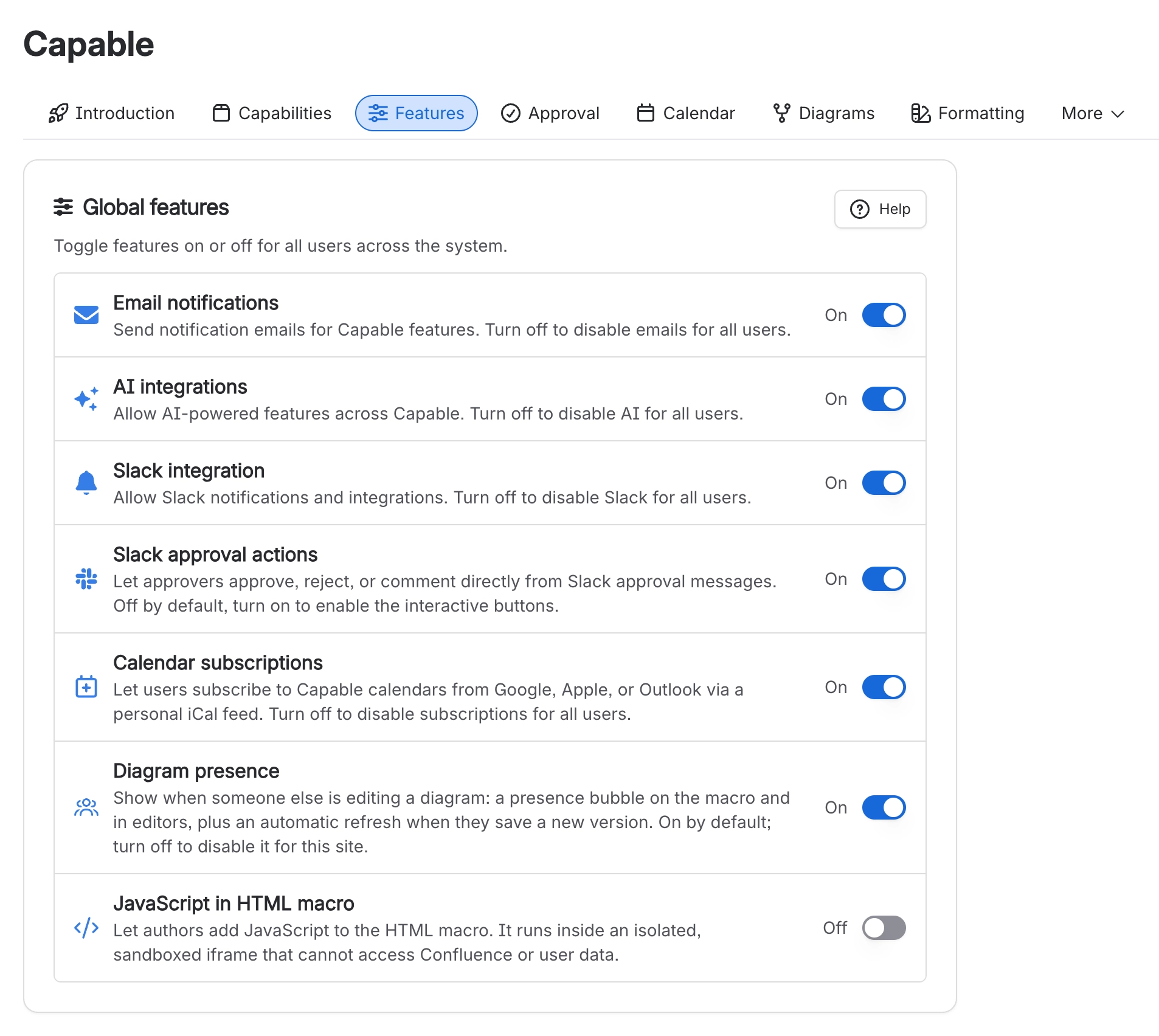
Features | Site-wide on/off switches: Email notifications (on), AI integrations (on), Slack integration (on), Slack approval actions (off), Calendar subscriptions (on), Diagram presence (on), JavaScrip |
Approval status banner | Shows a coloured banner above pages that have an approval. Off by default. Easy to miss because it sits on the Approval tab above the inner tabs, not on the Features tab. |
Approval: Teams, Team permissions, Auth tokens, Slack channels | Define approval teams; name who may administer them (org admins and the Confluence admin groups are locked in); manage two-factor auth tokens; and wire Confluence spaces to Slack channels fo |
Egress | Approve up to 10 external domains the app may reach directly, choosing per domain which uses are allowed (images, fetch client-side, fetch backend-side, frames, media, scripts, styles, fonts |
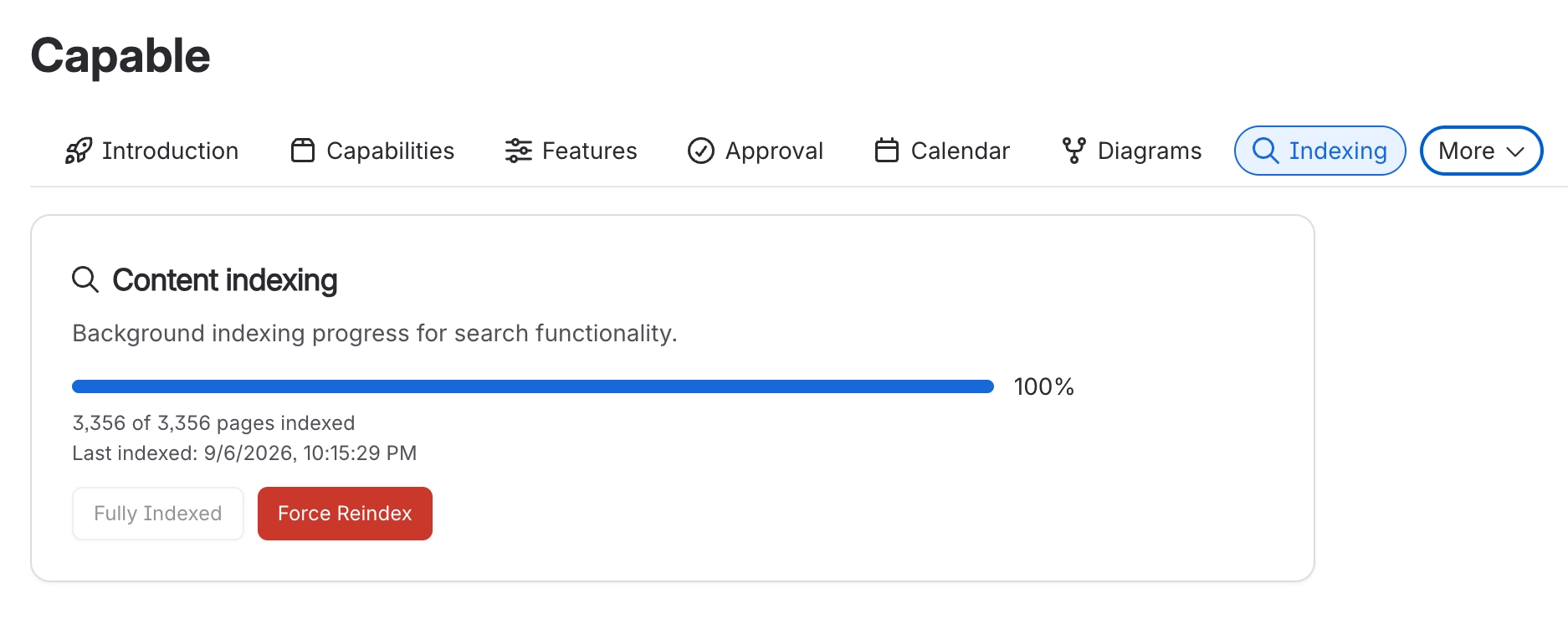
Indexing | Shows index coverage and last run, refreshing every 30 seconds, and can run indexing on demand in batches with a force-reindex option. This is what makes search filters, quality reports and |
Migration | A Find, Verify, Migrate, Undo wizard that converts another vendor's macros (26 source apps supported) or a Capable standalone app's content into Suite equivalents. The run happens in the bro |
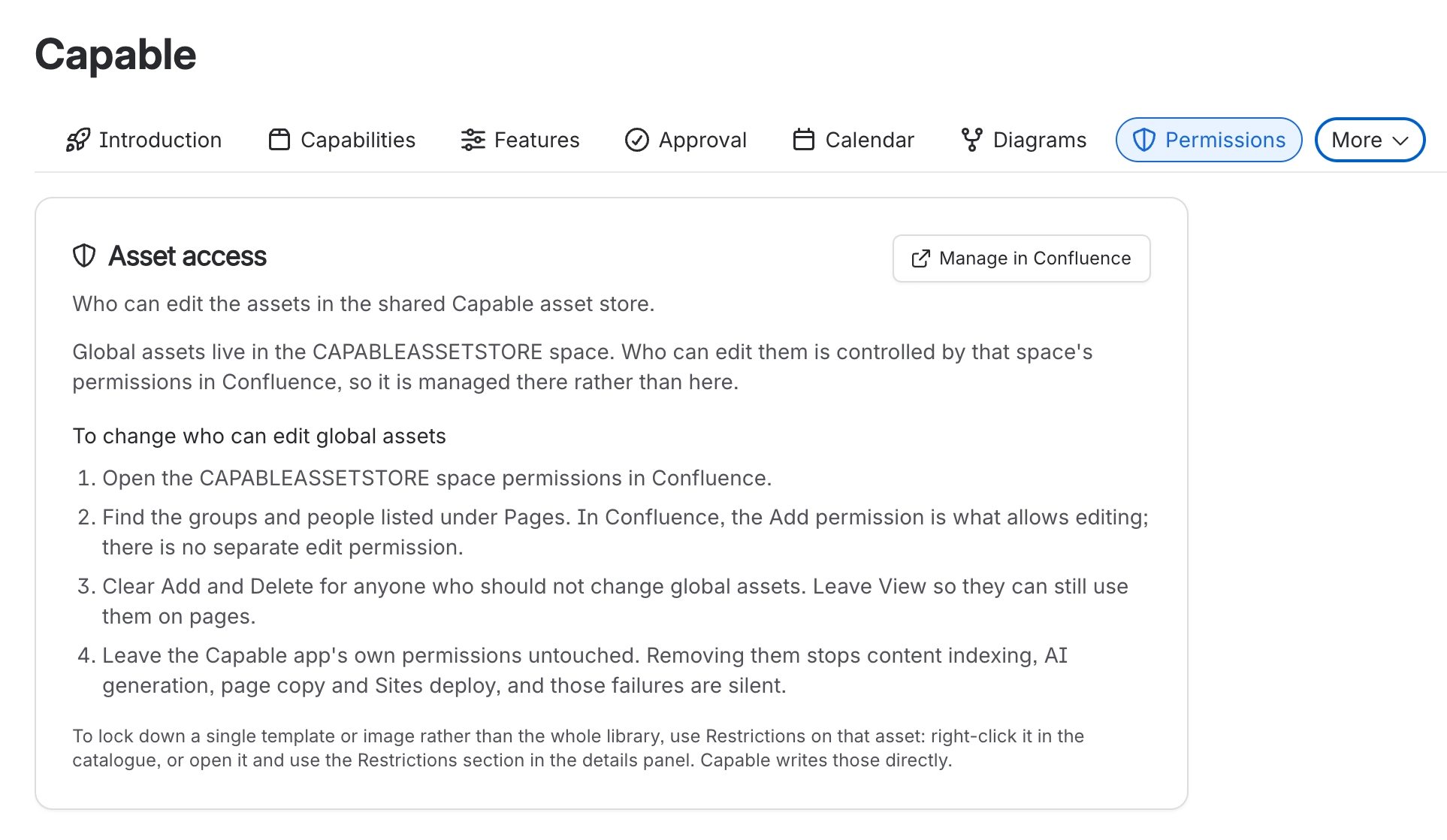
Permissions | Instructions only, not a control. Capable cannot write space permissions, so it explains that shared assets live in the Capable Asset Store space and links out to that space's Confluence per |
Diagrams: disabled libraries | Turn individual diagram languages off. TikZ is off out of the box. A disabled library disappears from the create picker, examples, AI generation and import, but diagrams already on pages kee |
Global settings has no Save button. Features and Approval changes auto-save about two seconds after your last click, with no confirmation. Navigating away immediately after a change can lose it. Pause before you leave the page.
#Capabilities
#Features
Site-wide on/off switches: Email notifications (on), AI integrations (on), Slack integration (on), Slack approval actions (off), Calendar subscriptions (on), Diagram presence (on), JavaScript in HTML macro (off). Rows only appear when an installed capability uses that feature. Auto-saves about two seconds after the last change with no Save button and no confirmation. There is no per-space equivalent.
#Egress
Approve up to 10 external domains the app may reach directly, choosing per domain which uses are allowed (images, fetch client-side, fetch backend-side, frames, media, scripts, styles, fonts). Available in the Suite and in the standalone Markdown, Formatting and Diagrams apps only.
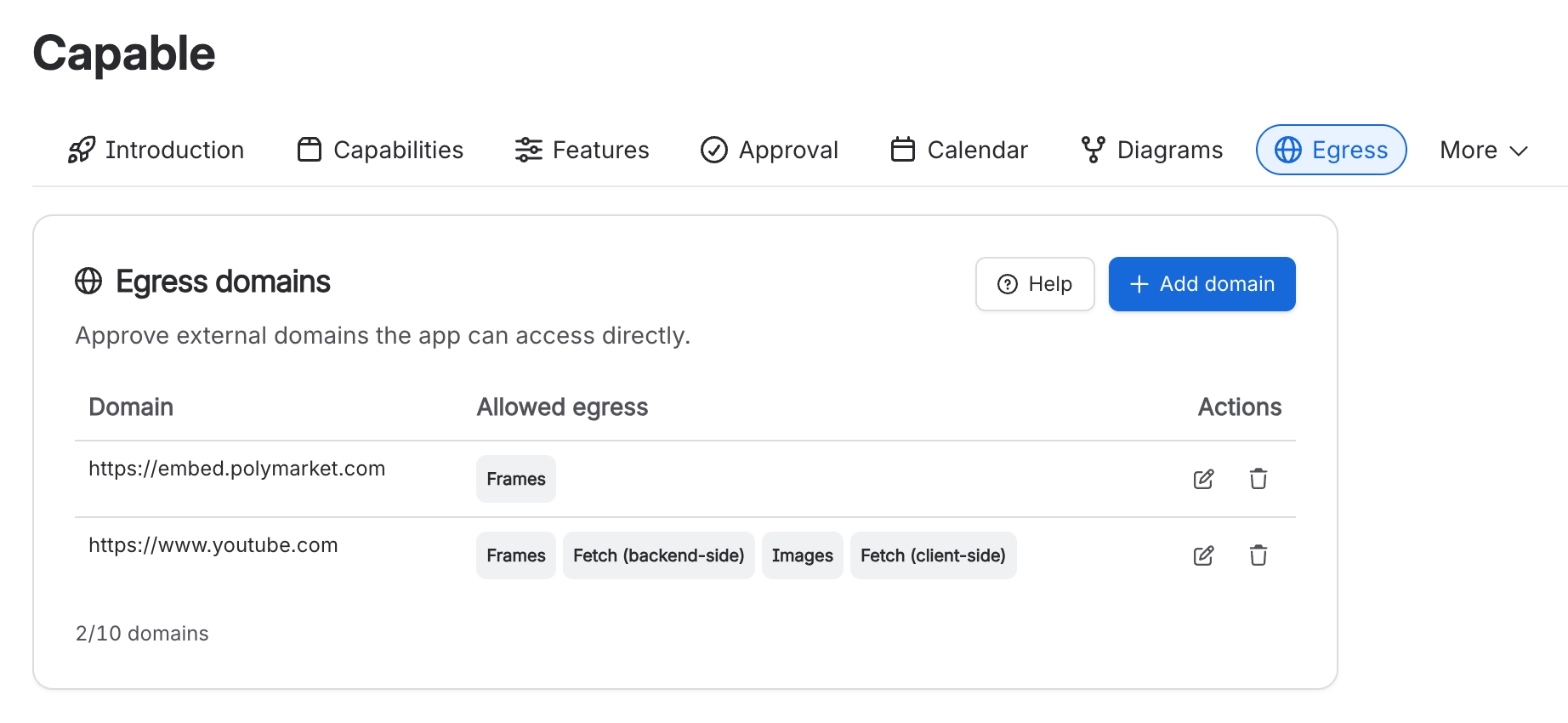
Approving a domain is a security decision. It lets the app reach that domain directly. Approve only domains you control or trust, and review the list periodically.
#Indexing
Shows index coverage and last run, refreshing every 30 seconds, and can run indexing on demand in batches with a force-reindex option. This is what makes search filters, quality reports and "Auto" bylines populate.
#Permissions
Instructions only, not a control. Capable cannot write space permissions, so it explains that shared assets live in the Capable Asset Store space and links out to that space's Confluence permissions screen. Warns that removing the Capable app's own space permissions silently breaks indexing, AI generation, page copy and Sites deploy.
#A few things worth knowing
Changes propagate in about a minute, and up to five in an already-open tab. Do not conclude a setting failed because it has not appeared yet.
While a migration is running the whole settings section is frozen, and the run lives in the browser tab.
The Permissions tab is instructions rather than a control: Capable cannot write space permissions.
#Related
No Save button. Pause before you leave.