
What Attio for Jira does
An agent opens a request and asks the same question every time: who is this, and what are we to them. The answer is usually in the CRM, in another tab, behind a search for an email address the issue does not show. Most agents stop asking after the first few tickets.
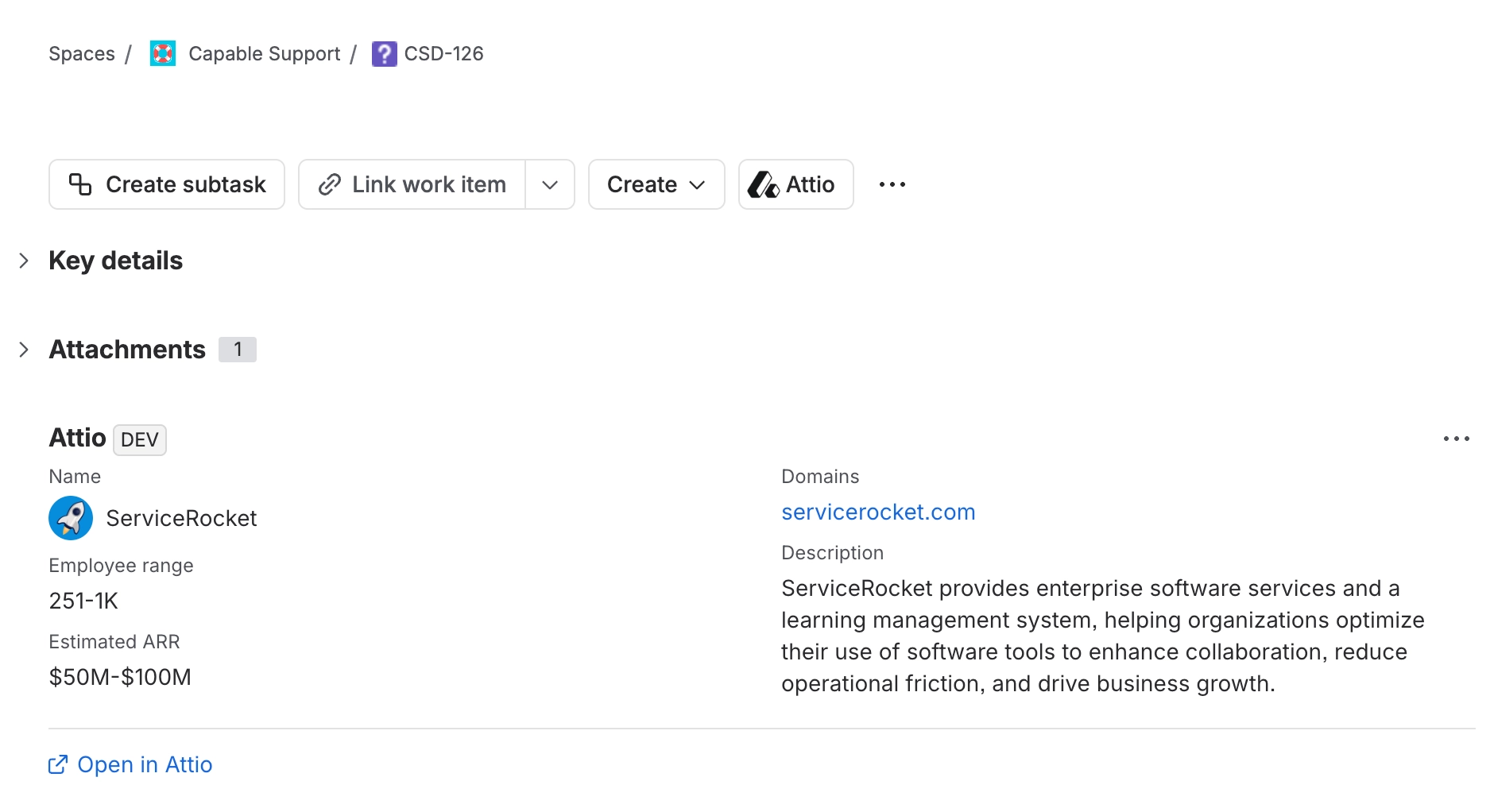
Attio for Jira answers it on the issue. It takes the reporter's email address, finds the matching record in your Attio workspace, and shows the attributes a project administrator chose, in the order they chose them. Nothing is typed, nothing is searched and nothing is copied between systems.
#Who it is for
Three people meet this app, and they meet different parts of it.
Reader | What they get |
|---|---|
A service management agent | The customer card on the request. They configure nothing and there is nothing for them to switch on. |
A project administrator | The Attio page in that project's settings, listed as "Attio" with the line "Connect this project to an Attio workspace". |
A Jira site administrator | A read-only site-level page called "Attio for Jira", listing every project on the site that has connected an Attio workspace. It never handles keys. |
#Where the card appears on an issue
There are three possible places for the card, all labelled "Attio". They are independent switches rather than a choice of one, so a project can use two or all three at once.
Placement | What it is | Shape |
|---|---|---|
Issue panel | "A panel on the issue itself, above the activity area." | "Full width of the issue, variable height." |
Activity tab | "A tab at the bottom of the issue, beside Comments and History." | Full width, and the tab shows its name without an icon, because Jira does not allow one there. |
Issue sidebar | "A collapsible panel in the right-hand column, under the issue details." | "Narrow, and the reader can resize it." Until it is expanded the reader sees a button reading "Attio". |
All three show exactly the same card with exactly the same information. The only difference is the room available: the card measures its own width and lays labels above values when it is narrow, beside them from about 380 pixels, and flows into two columns from about 700. Dragging the sidebar wider changes the layout as you drag.
#What is on the card
The card is a list of the chosen attributes and one link, and nothing else. There is no title bar, no record name heading and no line saying when the values were fetched. The record's own name appears only if an administrator put that attribute on the card.
One row per attribute, in the administrator's order rather than Attio's.
Row labels follow the attribute's current name in Attio, so renaming an attribute there changes the card without anybody revisiting the settings.
An attribute with nothing in it still shows its label with "None" underneath, because a vanished row reads as "this customer has no such field".
Values are formatted for the reader's own locale: numbers, currency, dates and times need no configuration.
A single control at the bottom left reads "Open in Attio" and opens that record in Attio.
#What the card says when there is no record to show
The states below are ordinary events rather than faults, and each has its own fixed wording.
Situation | What an agent sees |
|---|---|
The request has no reporter, which is common for requests raised by email or through a login-free portal | "This request has no reporter, so there is no customer to look up." |
Jira will not give the app an address for the reporter | "No email address is available for this reporter." No reason is offered, because a hidden address and an absent one cannot be told apart. |
Attio holds no matching record | "No Attio record matches this reporter." A project administrator also sees "Which Attio attribute reporters are matched on is a project setting." and a link reading "Open project settings". |
Several records match | "More than one record matches this reporter.", or "4 or more records match this reporter.", followed by up to three candidates with a link to open each one in Attio. |
Attio has stopped accepting the project's key | "The Attio connection for this project needs attention." Only a project administrator is offered the settings link. |
Attio has asked the app to slow down | With rows already on screen, a quiet note under them: "Attio is rate limiting this app, so these values may be out of date." With nothing to show, the whole card becomes "Attio is rate limiting this app. Try again in a minute." with a "Try again" control. |
Two cases render nothing at all. A viewer who does not meet the project's chosen audience gets no card and no message, because saying "you cannot see this" is itself information about the customer. An agent on a project whose setup is unfinished also gets nothing: only a project administrator is told which piece of setup is missing. To either reader the app looks absent rather than restricted, so a missing panel is not on its own evidence of a fault.
#Service management projects, and agents
The three card placements and the project settings page are offered on Jira Service Management projects only, to signed-in users with service management agent access. In a business or software project the app adds nothing at all, not even a settings page, so there is nothing to set up there.
A project administrator can narrow the audience further on the Permissions step, but that setting cannot widen it. Even the widest option, whose hint reads "The widest option. Every licensed user who can browse this project sees the card.", still reaches only agents on that project. Customer CRM data is never put in front of an unlicensed or anonymous viewer, so nobody arriving through the customer portal ever sees the card.
#What it will not touch
Every call the app makes to Attio is a read. It never creates, edits or deletes anything in your CRM, and it holds no permission to. In Jira it writes one thing: a small non-secret flag on the project recording whether setup is finished and which placements were chosen, which is what lets Jira hide the card in projects that are not ready. It never writes to your issues.
#A few things worth knowing
A missing card is a normal state, not a symptom. A viewer outside the chosen audience and an agent on a half-configured project both see no element on the issue at all.
Turning on all three placements shows the same information three times on one request. The usual combination is the sidebar for a glance and the activity tab for the detail.
The card is offered on service desk projects only. Adding the app does not put an Attio page into a software or business project's settings, so there is no screen there to connect anything from.
#Related
One card, three places to put it, and no typing.