Voorraadbeheer (DBML)
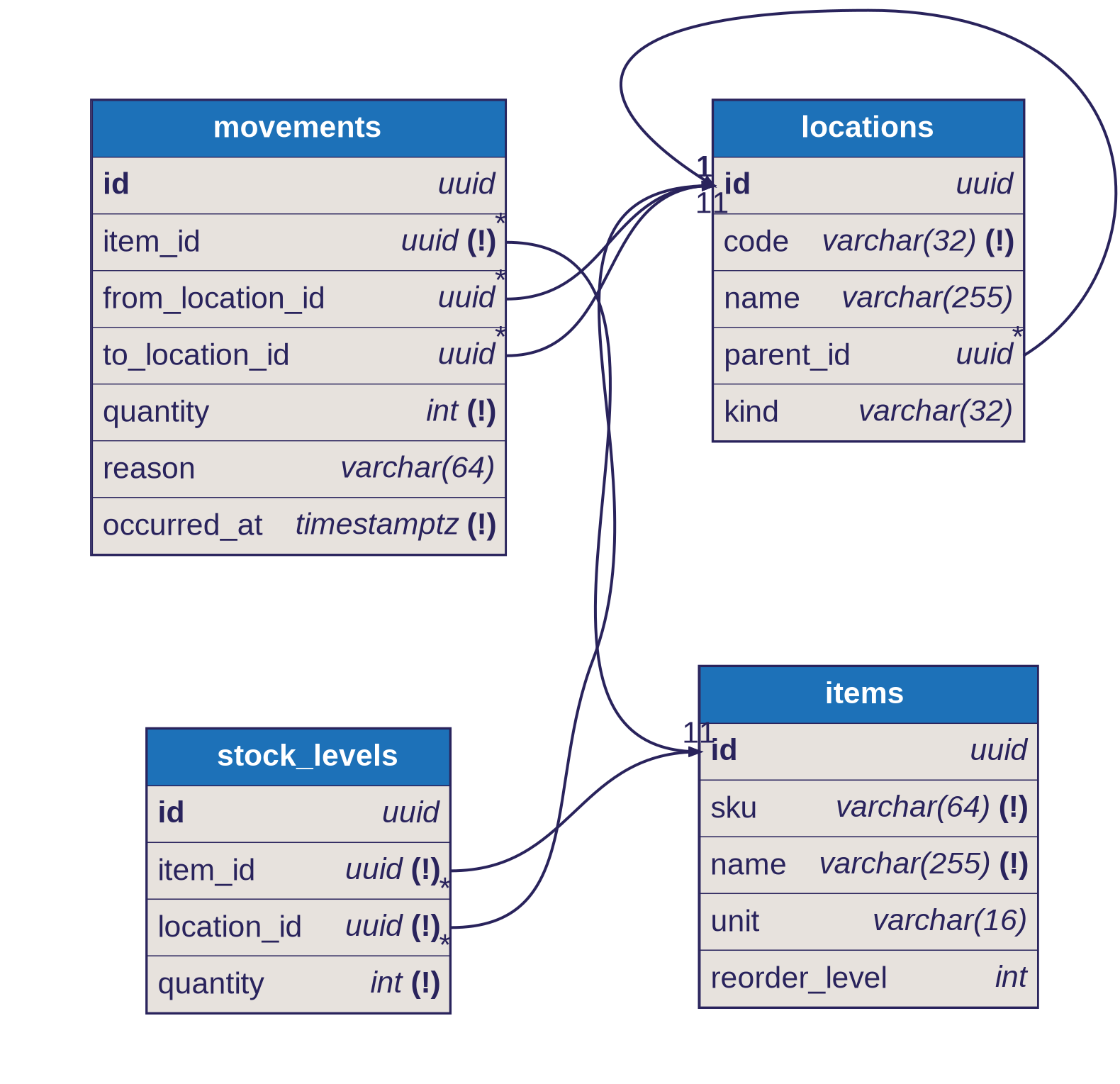
Een voorraadschema is een goed DBML-voorbeeld, omdat het interessante deel de mutatietabel is, waar de meeste regels in zitten.
#Wat dit voorbeeld laat zien
Een mutatietabel met een hoeveelheid met teken in plaats van aparte tabellen voor inkomend en uitgaand.
Samengestelde unieke beperkingen over twee kolommen.
Een zelfverwijzende hiërarchie voor locaties.
#Een uitgewerkt voorbeeld
Open het, bewerk het of kopieer de onderstaande bron.
De bron, die je kunt plakken in een nieuw diagram en bewerken:
Table locations {
  id uuid [pk]
  code varchar(32) [unique, not null]
  name varchar(255)
  parent_id uuid [ref: > locations.id, note: 'Null for a top-level site']
  kind varchar(32) [note: 'site, zone, aisle, bin']
}

Table items {
  id uuid [pk]
  sku varchar(64) [unique, not null]
  name varchar(255) [not null]
  unit varchar(16) [default: 'each']
  reorder_level int [default: 0]
}

Table stock_levels {
  id uuid [pk]
  item_id uuid [ref: > items.id, not null]
  location_id uuid [ref: > locations.id, not null]
  quantity int [not null, default: 0]

  Indexes {
    (item_id, location_id) [unique]
  }
  Note: 'Derived from movements; kept for fast reads'
}

Table movements {
  id uuid [pk]
  item_id uuid [ref: > items.id, not null]
  from_location_id uuid [ref: > locations.id]
  to_location_id uuid [ref: > locations.id]
  quantity int [not null, note: 'Always positive; direction comes from the locations']
  reason varchar(64) [note: 'receipt, transfer, pick, adjustment, writeoff']
  occurred_at timestamptz [not null, default: `now()`]

  Indexes {
    (item_id, occurred_at)
  }
}
#Maak het helemaal van jezelf
Een zelfverwijzing (parent_id naar dezelfde tabel) is de manier om in DBML een hiërarchie te tekenen.
Kolomnotities zijn de goedkoopste documentatie die je ooit zult schrijven.
Markeer afgeleide tabellen als afgeleid, anders schrijft iemand er rechtstreeks naartoe.
Dicht genoeg bij het schema om correct te blijven.